_edited_edited.jpg)


Best GloriaFood Alternatives for Restaurants in 2026

The online food ordering industry has undergone a seismic shift since GloriaFood first popularized free, widget-based restaurant ordering systems. In 2026, restaurant owners, food tech entrepreneurs, and multi-location chains are actively searching for a GloriaFood clone not just to replicate what GloriaFood does, but to surpass it.
The demand is no longer just about getting an ordering button on a website. Today's restaurant businesses want branded mobile apps, delivery fleet management, loyalty programs, POS integrations, and critically full data ownership. They want solutions that scale from a single café to a nationwide franchise without switching platforms midway.
This comprehensive guide covers everything you need to know about the best GloriaFood clone alternatives in 2026: what features matter most, which platforms lead the market, and how to choose the right solution for your specific business model.
Why Restaurants Are Moving Away from GloriaFood in 2026
GloriaFood built its reputation by offering commission-free online ordering for restaurants at no upfront cost. For a single-location pizza shop or neighborhood café, that value proposition was hard to beat.
But the landscape has changed. Here's why more restaurant businesses are actively searching for a GloriaFood clone or replacement:
1. Platform Dependency and SaaS Risk
When your entire ordering infrastructure runs on a third-party SaaS platform, you're one policy change or acquisition away from disruption. Restaurant owners have grown cautious after seeing similar platforms shut down, impose new fees, or get acquired and rebranded. A self-hosted GloriaFood clone eliminates this dependency entirely.
2. Limited Scalability for Multi-Restaurant Businesses
GloriaFood was fundamentally designed for individual restaurants. Entrepreneurs who want to build food delivery marketplaces, ghost kitchen networks, or multi-brand cloud restaurant businesses quickly find that GloriaFood's architecture simply wasn't built for that scale. A true GloriaFood clone built on marketplace infrastructure can accommodate unlimited vendors from day one.
3. No Mobile App for Customers or Delivery Partners
In 2026, customers expect dedicated mobile apps not just mobile-optimized web pages. The absence of native iOS and Android apps for ordering, and the lack of a delivery partner app for logistics, puts GloriaFood at a structural disadvantage against competitors.
4. Branding Constraints
GloriaFood operates as a widget embedded in your site. While functional, it doesn't give you a truly white-labeled product. Your customers interact with GloriaFood's interface rather than a fully branded experience under your restaurant's identity.
5. Limited Marketing and CRM Features
Modern restaurant businesses need push notifications, SMS marketing, loyalty points, discount engines, referral programs, and customer segmentation. GloriaFood's marketing toolset is basic compared to what dedicated GloriaFood clone platforms now offer.
Suggested Read: Top 5 Profitable Niches to Start a Restaurant Business
Key Features to Look for in a GloriaFood Clone in 2026
Before evaluating specific platforms, it's important to establish what a superior GloriaFood clone should include:
White-label branding — Your logo, domain, colors, and custom mobile app
Multi-restaurant / multi-vendor support — Ability to onboard multiple restaurant brands or locations
Customer-facing mobile apps — Native iOS and Android apps, not just responsive web
Delivery management system — Real-time driver tracking, zone management, and dispatch automation
Commission-free or flexible monetization — Subscription, commission, or hybrid models you control
Marketing tools — Loyalty rewards, push notifications, discount campaigns, referral systems
POS and third-party integrations — Seamless sync with Square, Clover, Stripe, WhatsApp, and CRMs
Self-hosted or cloud-hosted options — Full data ownership vs. managed SaaS
Easy menu migration — Import menus from existing systems without manual re-entry
Analytics and reporting dashboards — Revenue tracking, order trends, customer behavior
Now, let's examine the top five GloriaFood clone alternatives that check these boxes in 2026.
Top 5 GloriaFood Clone Alternatives in 2026
1. Yo!Yumm — Best Overall GloriaFood Clone Alternative
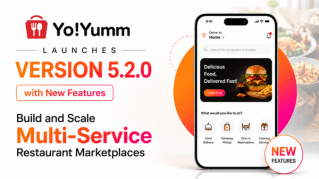
When it comes to building a complete GloriaFood clone that goes far beyond restaurant widgets, Yo!Yumm stands alone at the top of the market in 2026.
Yo!Yumm is a fully white-labeled, multi-vendor food ordering marketplace platform designed for entrepreneurs who want to build their own UberEats or DoorDash-style ecosystem — not just replace a single restaurant's ordering widget. This is precisely what makes it the strongest GloriaFood clone solution available today.
Key Features of Yo!Yumm:
Fully white-label marketplace platform — Your brand, your domain, your mobile apps
Multi-restaurant and multi-vendor architecture — Onboard unlimited restaurant partners with individual dashboards
Native mobile apps — Separate apps for customers, delivery partners, and restaurant owners
Flexible monetization models — Commission-based, subscription-based, or hybrid revenue streams
Self-hosted ownership model — You own the codebase and your customer data, with no SaaS shutdown risk
Advanced delivery management — Real-time tracking, driver allocation, zone configuration, and dispatch automation
Built-in marketing tools — Loyalty programs, discount management, and customer engagement features
Scalable infrastructure — Handles growth from a local pilot to a regional or national marketplace
Why Yo!Yumm Ranks #1 as a GloriaFood Clone:
The fundamental difference between Yo!Yumm and GloriaFood is scope. GloriaFood is a tool for individual restaurants. Yo!Yumm is a platform for building entire food delivery ecosystems. If your goal is to create a branded, commission-free, scalable ordering business — whether for your own restaurant chain or as a third-party marketplace — Yo!Yumm provides the complete infrastructure to do it.
For entrepreneurs and enterprise restaurant groups searching for a true GloriaFood clone that they can own and scale without limits, Yo!Yumm is the definitive choice in 2026.
2. Applova
For single-location restaurants and small chains that want a simple, commission-free online ordering upgrade from GloriaFood, Applova is an excellent alternative.
Applova positions itself as a DIY ordering platform designed for restaurant owners who don't want to rely on developers or technical teams. Its streamlined setup process means a restaurant can go live with online ordering in a matter of hours.
Key Features of Applova:
Commission-free online ordering — No per-order fees eating into margins
POS integrations — Native connections with Clover, Square, and other popular POS systems
No developer required — Self-service menu setup with intuitive tools
QR code ordering — Dine-in ordering via QR codes for contactless table service
Digital menu boards — Dynamic display menus for in-store use
Loyalty and rewards — Basic loyalty features for repeat customer engagement
Limitations vs. a Full GloriaFood Clone:
Applova is purpose-built for independent restaurants and small multi-location chains. It does not support multi-vendor marketplace models, which limits its use for entrepreneurs wanting to build a food ordering platform. The mobile app experience is also more limited than full-scale GloriaFood clone platforms like Yo!Yumm.
Best For: Independent cafes, QSRs, food trucks, and small restaurant chains looking for a clean GloriaFood replacement with POS integration.
3. CloudWaitress
CloudWaitress fills the niche of restaurants that need an extremely straightforward, no-frills online ordering setup. As a GloriaFood clone alternative for simplicity, it competes well for entry-level use cases.
Key Features of CloudWaitress:
Easy menu setup — Upload your menu and go live quickly
Commission-free ordering — No percentage taken from orders
Mobile-friendly ordering pages — Responsive design works across devices
Multiple order types — Takeaway, delivery, and dine-in ordering supported
Table booking system — Reservation management included
Free tier available — Low-barrier entry for restaurants testing online ordering
Limitations:
CloudWaitress does not offer native mobile apps for customers or delivery partners, multi-vendor support, or advanced marketing features. It's best understood as a functional, lightweight GloriaFood clone alternative — not a scalable platform.
Best For: Single-location restaurants, pop-ups, and food businesses that need basic online ordering without complexity or cost.
Suggested Read: How to Build & Launch a Food Delivery App in 7 Days?
4. Flipdish
For established restaurant brands, franchise groups, and large chains, Flipdish represents the enterprise end of the GloriaFood clone spectrum.
Flipdish is a full-stack digital ordering and marketing platform built to handle the operational complexity of multi-location restaurant businesses. Unlike GloriaFood — which scales poorly above a handful of locations — Flipdish was designed from the ground up for franchise-level deployments.
Key Features of Flipdish:
Branded mobile apps — Custom iOS and Android apps under your restaurant's branding
Multi-location management — Centralized control over menus, pricing, and promotions across all locations
Advanced marketing automation — Email, SMS, and push notification campaigns with customer segmentation
Robust analytics — Revenue dashboards, customer lifetime value tracking, and location-by-location performance reporting
Kiosk solutions — Self-service ordering kiosks for dine-in environments
Loyalty programs — Points-based and tiered loyalty systems for customer retention
Limitations:
Flipdish operates as a SaaS platform, which means you don't own the underlying infrastructure. Pricing is enterprise-tier, making it less accessible for early-stage restaurant startups. It also doesn't support the multi-vendor marketplace model that platforms like Yo!Yumm provide.
Best For: Established restaurant chains, QSR franchises, and hospitality groups seeking a sophisticated GloriaFood clone with enterprise-grade features and support.
5. FoodChow
FoodChow rounds out the top five as a platform that combines online ordering with built-in delivery management — an important combination for restaurants running their own delivery operations.
Key Features of FoodChow:
Integrated delivery tracking — Real-time order tracking for customers and delivery staff
Multi-location support — Manage multiple restaurant branches from one dashboard
Ordering and logistics combined — Both customer-facing ordering and delivery management in a single platform
Delivery zone management — Configure delivery areas, minimum order values, and fees by zone
Customer mobile app — Basic ordering app for customer convenience
Limitations:
FoodChow's design and feature depth don't match the more polished platforms in this list. The marketing and analytics tools are relatively basic, and scalability to large marketplace models is limited.
Best For: Delivery-heavy restaurants and small multi-branch operators that need a single platform combining ordering and logistics without the complexity of enterprise software.
GloriaFood Clone Comparison Table (2026)
Feature | Yo!Yumm | Applova | CloudWaitress | Flipdish | FoodChow |
Business Model | Marketplace (GloriaFood clone) | Single restaurant | Single restaurant | Enterprise chain | Hybrid |
Ownership | Full (self-hosted) | SaaS | SaaS | SaaS | SaaS |
Best For | Large-scale platforms | Small restaurants | Simple setups | Franchises | Delivery businesses |
Native Mobile App | Yes (customer + driver) | Limited | No | Yes | Yes |
Multi-Vendor Support | Yes | No | No | No | Limited |
Commission Model | Fully customizable | No commission | No commission | Mixed | Mixed |
Delivery Management | Advanced | Basic | Basic | Advanced | Advanced |
Marketing Tools | Advanced | Basic | Minimal | Advanced | Basic |
Scalability | Very High | Low–Medium | Low | High | Medium |
Self-Hosted Option | Yes | No | No | No | No |
The Case for a Self-Hosted GloriaFood Clone
One of the most important distinctions in this comparison is the question of ownership. Four of the five platforms in this guide operate as Software-as-a-Service meaning your data, your customers, and your ordering infrastructure live on someone else's servers under someone else's terms.
A self-hosted GloriaFood clone like Yo!Yumm means:
Your data belongs to you — Customer emails, order history, and behavioral data are assets you own
No SaaS shutdown risk — If the vendor closes or pivots, your platform continues operating
Flexible customization — Modify the platform to fit your brand and operational needs without waiting on a vendor roadmap
Better unit economics long-term — A one-time license or development investment often outperforms years of SaaS subscription fees at scale
For serious restaurant entrepreneurs building long-term businesses, the self-hosted model isn't just a technical preference — it's a strategic business decision.
Conclusion
As the online food ordering industry continues to evolve, businesses require solutions that offer greater flexibility, scalability, and control over their operations. Modern restaurant owners are no longer looking only for a way to accept online orders; they also need tools that support customer engagement, delivery management, branding, data ownership, and long-term growth.
When evaluating alternatives, it is important to consider factors such as business size, future expansion plans, customization requirements, and operational needs. A solution that works well for a small restaurant may not be suitable for a growing chain or a business planning to expand into multiple locations.
Ultimately, the ideal choice is one that aligns with your business objectives, provides a seamless customer experience, and supports sustainable growth. By carefully assessing your requirements and prioritizing features that deliver long-term value, you can build a stronger digital presence and stay competitive in an increasingly technology-driven restaurant industry.


Comments